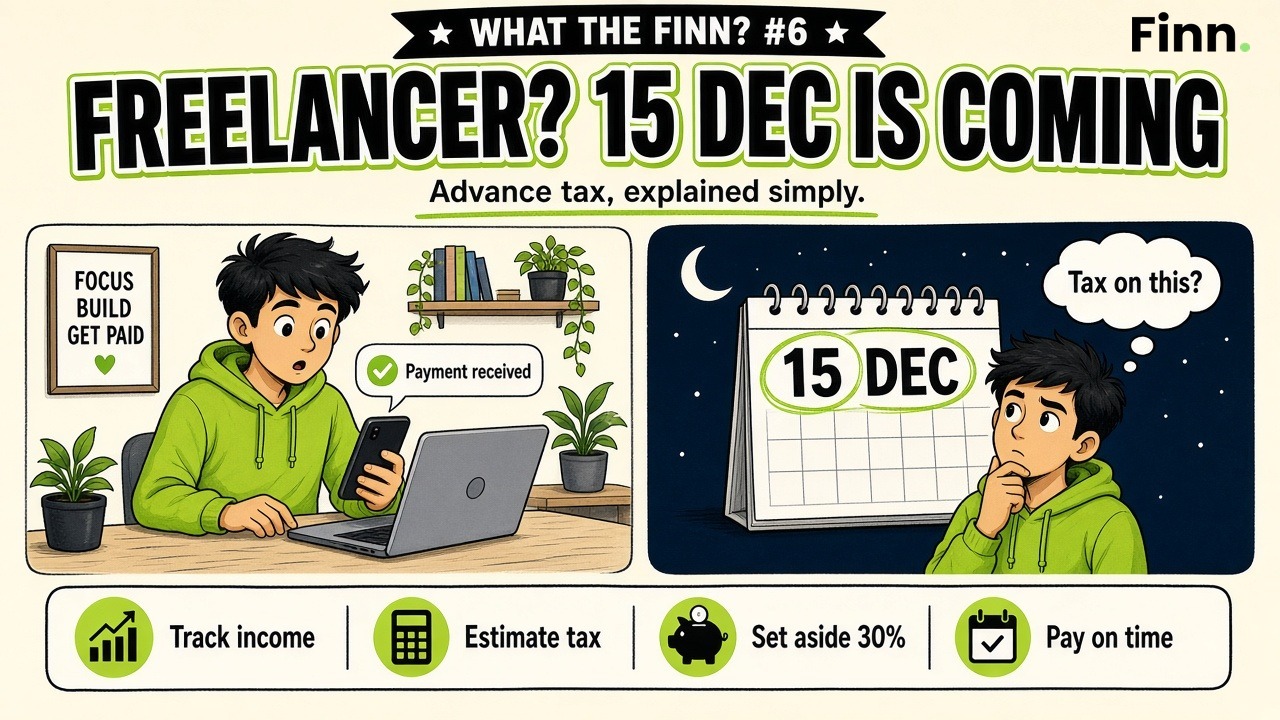
What the Finn? — Part 6
Last time, we talked about paying at a UPI QR with credit.
Small scans. Real debt.
Today, let's talk about a different kind of bill.
One that doesn't come with a statement.
Or a reminder.
Or an app notification.
Your tax.
The "Payment Received" Feeling 😄
You finish a design project.
Or a video edit.
Or a month of client work.
Your phone buzzes.
"₹48,000 credited."
Best notification in the world.
Now here's the question nobody asked you when you went freelance:
How much of that ₹48,000 is actually yours?
If you're salaried, your employer quietly handles this.
Tax gets deducted every month. You barely think about it.
If you're a freelancer, creator, consultant or gig worker?
Nobody does it for you.
And the Income Tax Department expects you to pay as you earn.
That's called advance tax.
And the next big date is 15 December 2026.
What Is Advance Tax? 🤔
Simple version:
Instead of paying all your tax when you file your return, you pay it in parts during the year.
The rule kicks in when your estimated tax for the year, after TDS, is ₹10,000 or more.
For Tax Year 2026-27 (that's 1 April 2026 to 31 March 2027), the dates are:
By each date, you should have paid this much in total:
- 15 June 2026: 15%
- 15 September 2026: 45%
- 15 December 2026: 75%
- 15 March 2027: 100%
These are cumulative.
So on 15 December, you're not paying "another 30%".
You're making sure the total you've paid so far reaches 75%.
Quick note: from this year, the new Income-tax Act, 2025 applies. The words changed a bit ("Tax Year" replaces "assessment year"), but the four advance tax dates stayed the same.
What Happens If You Miss It? 😬
No police. No drama.
Just interest.
If you pay less than you should by a due date, you pay simple interest of 1% a month on the shortfall.
For the December instalment, that works out to 3% on whatever you were short.
And unlike the June and September instalments, December doesn't come with a small tolerance buffer.
Short is short.
It's not a disaster.
But it's money you paid for nothing.
What the Finn? 💸
The Shortcut Some Freelancers Can Use 🧾
There's a scheme called presumptive taxation.
If you're in a specified profession (software developers and IT freelancers are covered in the new law, along with doctors, lawyers, architects, engineers and others), you can declare 50% of your gross receipts as profit, as long as your receipts stay under ₹50 lakh (₹75 lakh if cash is 5% or less of what you receive).
The big bonus?
You can pay your entire advance tax in one go, by 15 March 2027.
Nothing is due on 15 December.
But read this part slowly.
Not every freelancer qualifies. Graphic designers, writers, photographers and video editors aren't clearly named, and their position is unsettled.
So before you skip December, check with a CA whether the scheme fits your work.
How to Work Out Your December Number 🧮
You don't need to be perfect.
You need to be honest.
- Add up what you've earned since 1 April. Every client, every platform, every brand deal.
- Estimate the rest of the year. Use the contracts and invoices you realistically expect, not your dream pipeline.
- Work out the tax on the full-year estimate under the regime you'll choose.
- Subtract the TDS already deducted. Check your Form 26AS or AIS on the income tax portal. If what's left is under ₹10,000, no advance tax is due.
- Take 75% of what's left, then subtract what you paid in June and September. That's your December instalment.
Had a slow first half and a great Q3?
That's normal for freelancers.
Pay based on what you know now. If the year ends better than expected, the March instalment catches up.
4 Habits That Make Tax Season Boring (In a Good Way) ✅
1. Keep "my money" and "tax money" apart.
Every time a payment lands, move a slice into a separate savings account or FD. Many freelancers use 20–30% as a rough rule of thumb, but your real number depends on your income and regime.
2. Track income the day it arrives.
Not in March. Not from memory. The day it lands.
3. Put the four dates in your calendar.
15 June. 15 September. 15 December. 15 March.
4. Keep your records clean.
Invoices, TDS certificates and bank statements in one folder. Your future self (and your CA) will thank you.
Where FinnDot Fits In 💚
When we started building FinnDot, we kept hearing the same thing from freelancers and creators:
"I earn well. I just never know where I stand."
Income comes from five places.
Spending goes to fifty.
And tax shows up like a surprise guest.
FinnDot brings your financial data into one place.
Our AI expense tracking sorts your money automatically, so you can see what came in, what went out, and what's really left after you've set money aside.
We're also building FinnDot for people whose income doesn't arrive on the 1st of every month. Better visibility today means better credit decisions tomorrow, whether that's choosing the right credit card or building your credit score with a savings-account or FD-backed card.
FinnDot doesn't file your taxes.
But it helps you walk into tax season knowing your numbers.
👉 Download FinnDot on Google Play
Final Thought 🗓️
Freelancing gives you freedom.
Freedom to choose your work, your clients, your hours.
But it also hands you a job your employer used to do.
Advance tax isn't scary.
It's just a calendar reminder most of us never set.
So, honest question:
Do you set aside money for tax every time a payment lands, or do you sort it out in March? 👇
This post is for general information only and isn't tax advice. Your situation may differ, so please check with a qualified chartered accountant before you pay.