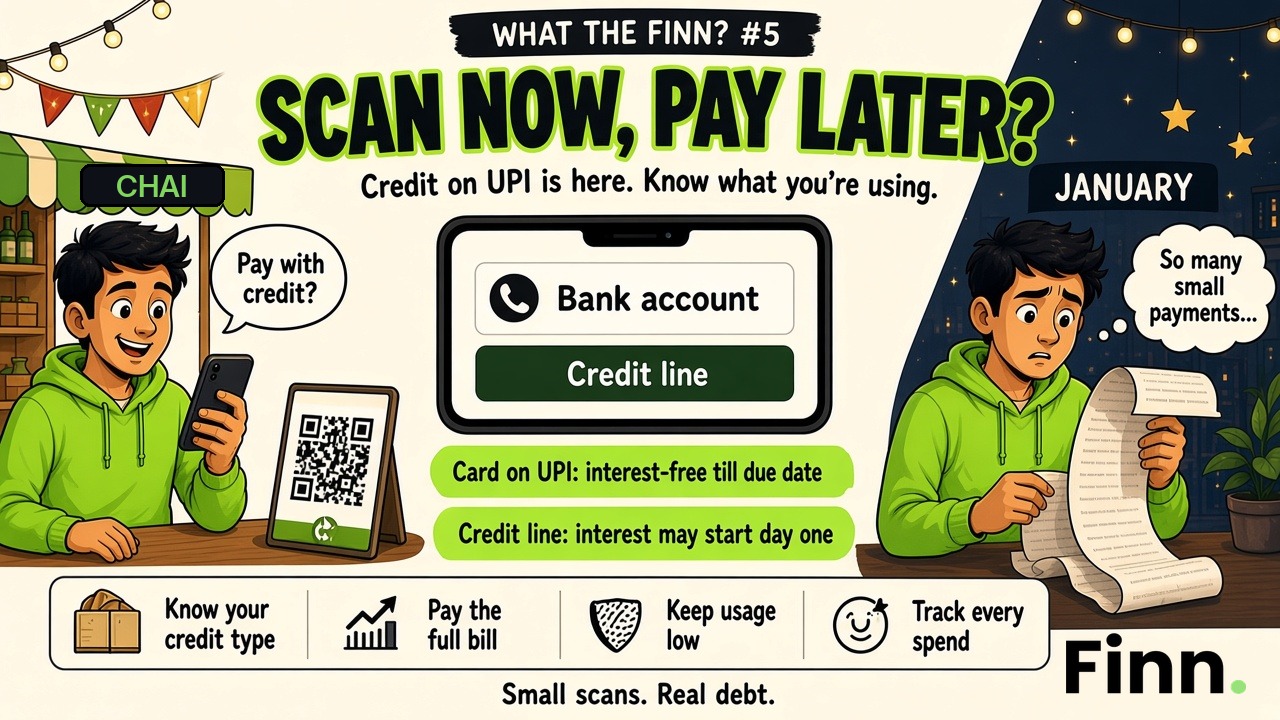
What the Finn? — Part 5
You're at the chai stall. Two chais. One bun maska. ₹60.
You scan the QR. Your UPI app asks a new question.
"Pay from bank account... or credit?"
A few years ago, that question didn't exist. UPI meant one thing. Money leaves your bank account. Instantly.
Not anymore.
What Is a Credit Line on UPI? 👀
Today, your UPI payment can come from three places:
- Your bank account (the classic).
- A RuPay credit card linked to UPI.
- A pre-sanctioned credit line from your bank.
The second one has been around since 2022. The third one is the new kid: a credit line on UPI.
In September, NPCI (the people who run UPI) released a consolidated rulebook for "Credit on UPI". It splits credit lines into two types and gives banks and UPI apps until 15 December 2026 to standardise how these accounts show up when you pay.
Translation? Very soon, "pay with credit" will look as normal as "pay with UPI".
And that's exactly why we need to talk about it.
UPI Credit Line vs RuPay Credit Card on UPI 🧐
Here's the part most people skip.
RuPay credit card on UPI It's your credit card, just paid through a QR. Pay the full bill by the due date, and you usually pay no interest. It works for merchant payments, not for sending money to friends.
Interest-free credit line (NPCI calls it CLIF) Like a card without the plastic. Interest-free only if you clear the entire outstanding by the due date.
Interest-bearing credit line (CLIB) This is the one to read slowly. Interest starts from the day you pay. Not from the due date. From the day of the transaction.
So that ₹60 chai? On the wrong product, it starts costing you more from the very first sip. ☕
What the Finn? 💳
Why This Is Bigger Than It Looks 📈
Credit cards used to need a card machine. UPI changed that.
According to a September 2026 analysis of RBI card data, India now has about 80 UPI QR codes for every card machine. RuPay credit cards, through UPI, can reach almost all of them.
The same report found that the average RuPay credit-on-UPI payment is just ₹851. Small. Frequent. Easy to forget.
And people are using these cards far more often. Industry executives quoted by Mint say UPI-linked RuPay cards see roughly 3.5 to 4 times as many monthly transactions as traditional cards.
That's the catch. Big purchases make you pause. Small ones don't.
₹60 here. ₹240 there. ₹851 on a Swiggy order you "deserved".
And at the end of the month, all those tiny scans arrive together. As one very adult bill.
The Credit Score Side of the Story 📊
Here's something people forget.
A credit line is still a loan. A credit card is still credit.
Moneycontrol put it simply: credit on UPI is still credit. Interest, billing cycles, late charges and the credit limit still apply. Missed or delayed repayments can lead to charges and may affect your credit record.
That cuts both ways.
Used well, regular small spends that you repay on time can help you build a credit history. Used carelessly, a few missed payments can follow you every time you apply for a loan or a card later.
Same tool. Very different outcomes.
So How Do You Use It Smartly? 🎯
1. Know what you've linked. Open your UPI app and check: is it a credit card, an interest-free line, or an interest-bearing line? The name on the screen matters less than the terms behind it.
2. Read the interest terms before your first payment. What's the rate? When does interest start? Is there a fee? If you can't answer these, don't use it yet.
3. Pay the full bill, not the minimum. On an interest-free product, paying the full amount by the due date is what keeps it free.
4. Keep your usage low. Using a big chunk of your limit leaves less room for real emergencies, and high usage can weigh on your credit profile.
5. Don't treat credit as a UPI balance. If your bank account says ₹2,000 and your credit line says ₹50,000, your real balance is still ₹2,000.
6. Track every small spend. The danger isn't one big swipe. It's forty small scans you don't remember.
7. Set autopay, but keep money in the account. Autopay only helps if there's money to pay from.
Where FinnDot Fits In 💚
This is exactly the kind of problem we think about at FinnDot.
Most apps tell you what you spent. Very few tell you what it means for you.
With your consent, FinnDot uses your financial data to track expenses automatically with AI, so those small UPI spends don't disappear into the month. It helps you understand and build your credit score. And if you're new to credit, it can point you to options that fit your situation, including savings-account-backed and FD-backed credit cards that help you start building a history safely.
No pressure. No hard sell. Just clarity before you tap "Pay".
👉 Download FinnDot on Google Play
What the Finn? 💰
UPI made paying easy. Credit on UPI makes borrowing just as easy.
That's not a bad thing. It can be convenient, rewarding, and even help you build a credit history.
But easy isn't the same as free.
So the next time your app asks, "Bank account or credit?"... Pause for one second.
Because that one second decides whether you're using credit. Or credit is using you.
Your turn: Have you linked a credit card or credit line to UPI yet? Did it make you spend more, or did it help you stay organised? Tell us in the comments. 👇
Sources
- NPCI UPI Consolidated Circular (Credit on UPI: CLIF and CLIB definitions, permitted uses, 15 Dec 2026 implementation deadline): https://www.npci.org.in/uploads/UPI_Consolidated_Circular_0641e910f7.pdf
- Mint, 20 Sep 2026 (circular released 18 September; RuPay card vs CLIF vs CLIB feature table; issuer decides eligibility and terms): https://www.livemint.com/money/personal-finance/credit-line-on-upi-from-rupay-cards-to-pre-sanctioned-loans-how-it-works-and-what-users-need-to-know-11789923576196.html
- Moneycontrol, 12 Oct 2026, "Scan now, repay later" (credit on UPI is still credit; missed repayments may affect credit record; RuPay on UPI is merchant-only): https://www.moneycontrol.com/news/business/personal-finance/scan-now-repay-later-how-credit-on-upi-actually-works-14050179.html
- RBI Commercial Banks (Credit Facilities) Fourth Amendment Directions, 23 Jun 2026 (UPI-linked credit lines follow the same norms as the underlying loan): https://www.rbi.org.in/scripts/BS_CircularIndexDisplay.aspx?Id=13528
- Card Express, 8 Sep 2026, "India's Credit Card Is Moving onto UPI" (about 80 UPI QR codes per card terminal; average RuPay credit-on-UPI ticket ₹851; based on RBI card statistics): https://cardexpress.in/research/india-credit-cards-2026
- Mint, "RuPay-on-UPI boosts card usage" (UPI-linked RuPay cards see about 3.5 to 4 times as many monthly transactions as traditional cards, per Zeta's Mehul Mistry): https://www.livemint.com/industry/banking/rupay-credit-cards-upi-monetization-banks-fintechs-credit-card-usage-11784887621642.html
- Moneycontrol, 6 Oct 2026 (government asks banks to push UPI credit lines for micro-business working capital; background): https://www.moneycontrol.com/news/business/economy/govt-asks-banks-to-step-up-digital-lending-to-micro-businesses-pushes-upi-credit-lines-14045964.html