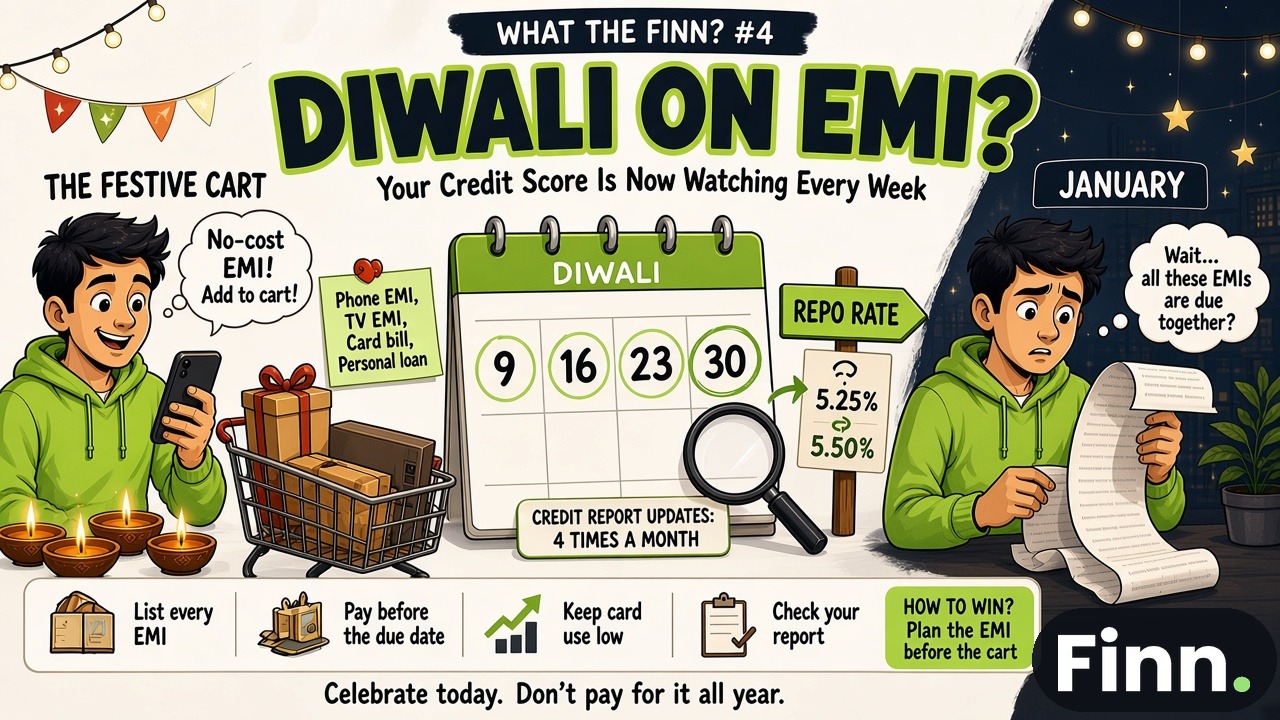
What the Finn? — Part 4
Last time, we asked a simple question:
What is financial freedom?
We said it's not about looking rich.
It's about having choices.
Today, let's test that idea.
Because the biggest test of the year is almost here.
Diwali. 🪔
Dhanteras is on 6 November.
Diwali is on 8 November.
And your shopping app already knows.
The Festive Cart 🛒
You open the app "just to check."
New phone.
Smart TV.
A gift for Amma.
A watch for yourself, because you "deserve it." 😎
The total looks scary.
But then you see two magical words:
No-cost EMI.
Suddenly ₹80,000 becomes "only" a few thousand a month.
Add to cart.
Add to cart.
Add to cart.
You are not alone.
On Amazon, the share of purchases made on no-cost EMI jumped to about 50% this festive season, from about 30% last year.
And a survey of 100 Indian cities found that 77% of urban Indians spend at least 50% more than usual during festivals.
So yes.
India is celebrating.
On instalments.
But Something Changed This Year 👀
Two things, actually.
And most people haven't noticed either of them.
Change #1: Money Got a Little More Expensive 📈
On 7 October, the RBI raised the repo rate by 0.25%, to 5.50%.
It's the first hike since February 2023.
The RBI also changed its stance to "calibrated tightening."
In simple words:
Cheap loans are not the plan right now.
Within days, banks like PNB, Bank of Baroda, Bank of India and Indian Bank raised their repo-linked lending rates by the same 0.25%.
What does that mean for you?
If you have a floating-rate loan, your EMI may go up.
Or your EMI stays the same and your loan runs longer.
Either way, you pay more interest.
If your loan is fixed-rate, it usually doesn't change.
And credit cards?
Your card's interest rate doesn't automatically jump with the repo rate.
If you pay the full bill every month, nothing changes for you.
If you carry a balance, you were already paying one of the most expensive rates in finance.
That part hasn't changed either. 😅
Change #2: Your Credit Report Now Updates Every Week 🗓️
This one is bigger than it sounds.
From 1 July 2026, the RBI asked lenders to send your credit data to the bureaus four times a month.
On the 9th, the 16th, the 23rd and the last day of every month.
Earlier, it was roughly once a month.
Think of it like this.
Your credit report used to be a monthly report card.
Now it's closer to a weekly class test. 📝
The good news:
Pay your EMI on time and close a loan, and it shows up much faster.
The not-so-good news:
Miss an EMI and that also shows up much faster.
The formula behind your score hasn't changed.
But your score now reacts to your behaviour much sooner.
The January Problem 🥶
Now put these together.
Festive cart.
Three or four new EMIs.
Slightly higher rates on floating loans.
A credit report that updates every week.
In November, everything feels fine.
The first EMIs are small.
The lights are bright.
The sweets are free. 🍬
Then January arrives.
Phone EMI.
TV EMI.
Card bill.
Maybe a personal loan for that "one last thing."
All due in the same week.
Usually the same week your rent is due. 😂
One missed date.
One late payment.
And it doesn't sit quietly for a month anymore.
It shows up on your report within days.
That's not a festival problem.
That's a planning problem.
And planning problems can be solved.
So How Do We Celebrate Smartly? 🎯
No, the answer is not "don't buy anything."
You worked hard all year.
Buy the phone. Buy the gift. Enjoy it.
Just do it with your eyes open.
1. List every EMI before you add a new one.
Not in your head. On paper or in an app.
Add the new EMI to the list and ask:
"Can I pay all of these even in my worst month?"
2. Read what "no-cost" really means.
Check the order summary for a processing fee or other charges before you confirm.
"No-cost" should mean no extra cost. Make sure it does.
3. Line up your due dates with your income.
If you're a freelancer or gig worker, your money doesn't arrive on the 1st.
Ask your lender or card issuer if you can move the due date closer to when you actually get paid.
4. Use autopay, but keep money in the account.
Autopay only helps if the balance is there.
A bounced autopay is still a missed payment.
5. Don't max out your credit card.
How much of your limit you use matters for your score.
Spreading a big purchase across a card that's already full can hurt even if you never miss a payment.
6. If you have a floating loan, check what your bank changed.
Did the EMI go up, or did the tenure get longer?
A longer tenure feels painless today and costs you more later.
7. Check your credit report after the festive season.
With weekly updates, mistakes also show up faster.
And so do your good habits.
And If You Don't Have a Credit Score Yet? 🤔
Here's the funny part.
Millions of Indians earn well, pay rent on time, and never miss a bill.
But when they apply for a credit card, the bank says:
"Sorry, we can't see your history."
Freelancers.
Gig workers.
Self-employed people.
First-jobbers.
They don't have a bad score.
They have no score.
Taking five festive EMIs is not the best way to build one. 😅
A safer start is something like a credit card backed by your own FD or savings.
Use it for small spends, pay it in full, and let your history grow slowly.
With weekly reporting, that good behaviour now shows up faster too.
Where FinnDot Fits In 💚
This is exactly the gap we're building FinnDot for.
With your consent, FinnDot connects your financial data through the Account Aggregator framework and processes it privately on your device.
Our AI expense tracker shows where your money is actually going, including the EMIs you forgot you signed up for in a festive hurry.
The FinnDot AI Assistant can help you answer the question that matters most:
"Can I really afford this, every month?"
And if your CIBIL history is thin or empty, FinnDot builds a behavioural credit profile from how you actually earn and spend, so lenders can see the stability that was always there.
We also help you explore credit score building options, like savings- and FD-backed secured cards.
Investments are coming soon.
No guarantees. No magic.
Just clearer decisions.
What the Finn? 💰
Your credit report used to be a monthly report card.
Now it's a weekly class test.
The festival lasts five days.
The EMIs can last twelve months.
So celebrate.
Light the diyas.
Buy the gift.
Eat one extra kaju katli. 😋
Just make sure your January self says "thank you," not "what the Finn?" 😂
Try FinnDot this Diwali and see all your EMIs and spending in one place before you add the next one to cart.
Happy Diwali from all of us at FinnDot! 🪔
See you in 15 days!
Sources
RBI Monetary Policy Statement, 7 Oct 2026 (repo rate +25 bps to 5.50%, stance "calibrated tightening"): https://www.rbi.org.in/Scripts/BS_PressReleaseDisplay.aspx?prid=63742
India Today, 7 Oct 2026 (first hike since February 2023; floating vs fixed personal loans): https://www.indiatoday.in/business/story/rbi-hikes-repo-rate-after-nearly-4-years-are-your-personal-loan-emis-set-to-rise-3011391-2026-10-07
Business Standard, 9 Oct 2026 (PNB, BoB, BoI, Indian Bank etc. raise repo-linked lending rates by 25 bps): https://www.business-standard.com/finance/personal-finance/major-banks-hike-loan-rates-after-rbi-move-check-if-your-emis-will-rise-126100900441_1.html
News18, 7 Oct 2026 (credit card rates don't automatically rise with repo; full payers unaffected): https://www.news18.com/business/savings-and-investments/rbi-raises-repo-rate-do-credit-card-users-need-to-worry-heres-what-changes-ws-l-10370820.html
RBI Credit Information Reporting Amendment Directions (reporting on 9th, 16th, 23rd, last day; effective 1 July 2026): https://www.rbi.org.in/Scripts/NotificationUser.aspx?Id=13180&Mode=0
Paisabazaar, CIBIL Score New Rules 2026 (score methodology unchanged; good and bad behaviour reflects sooner): https://www.paisabazaar.com/credit-score/cibil-score-new-rules-2026/
Times of India (Amazon no-cost EMI share ~50% vs ~30% last year): https://timesofindia.indiatimes.com/business/india-business/online-festive-sales-lower-aovs-bigger-share-of-purchases-through-emis/articleshow/134980296.cms
Pahle India Foundation / Amazon Pay survey via Prime Time 24 (77% of urban Indians spend at least 50% more during festivals; 100 cities): https://primetime24.com/en/story/mumbai-tops-festive-credit-card-use-in-survey-of-100-indian-cities-upi-leads-in/
Drik Panchang / timeanddate (Dhanteras 6 Nov 2026, Diwali 8 Nov 2026): https://www.drikpanchang.com/festivals/dhanteras/festivals-dhanteras-puja-timings.html , https://www.timeanddate.com/holidays/india/diwali