What the Finn? — Part 7
Last time, we talked about advance tax.
The bill that doesn't send you a reminder.
Today, let's talk about the money that comes from far away.
From a client in Austin.
Or Berlin.
Or Melbourne.
And the form that almost became your monthly headache.
The "Wait, Do I Need to File This?" Moment 😅
You finish a website for a client in the US.
They pay you $1,200.
It lands in your Indian bank account a few days later.
Then your bank writes to you.
Purpose of payment? Invoice copy? And something called an EDF?
If you got confused in October, you were not alone.
Here's what happened.
From 1 October 2026, RBI's new Foreign Exchange Management (Export and Import of Goods and Services) Regulations, 2026 came into force. Under them, an exporter of services has to declare the full export value in an Export Declaration Form (EDF), within 30 days from the end of the month in which the invoice is raised.
And here's the part many freelancers don't realise:
When you work for a client abroad, you're not "receiving money from abroad".
In FEMA language, you're an exporter of services.
Yes. You. With your laptop.
An exporter. 🚢
What RBI Changed on 2 November 🧾
On 2 November 2026, RBI notified an amendment (FEMA 23(R)/(2)/2026-RB). It applies retrospectively from 1 October 2026.
Simple version:
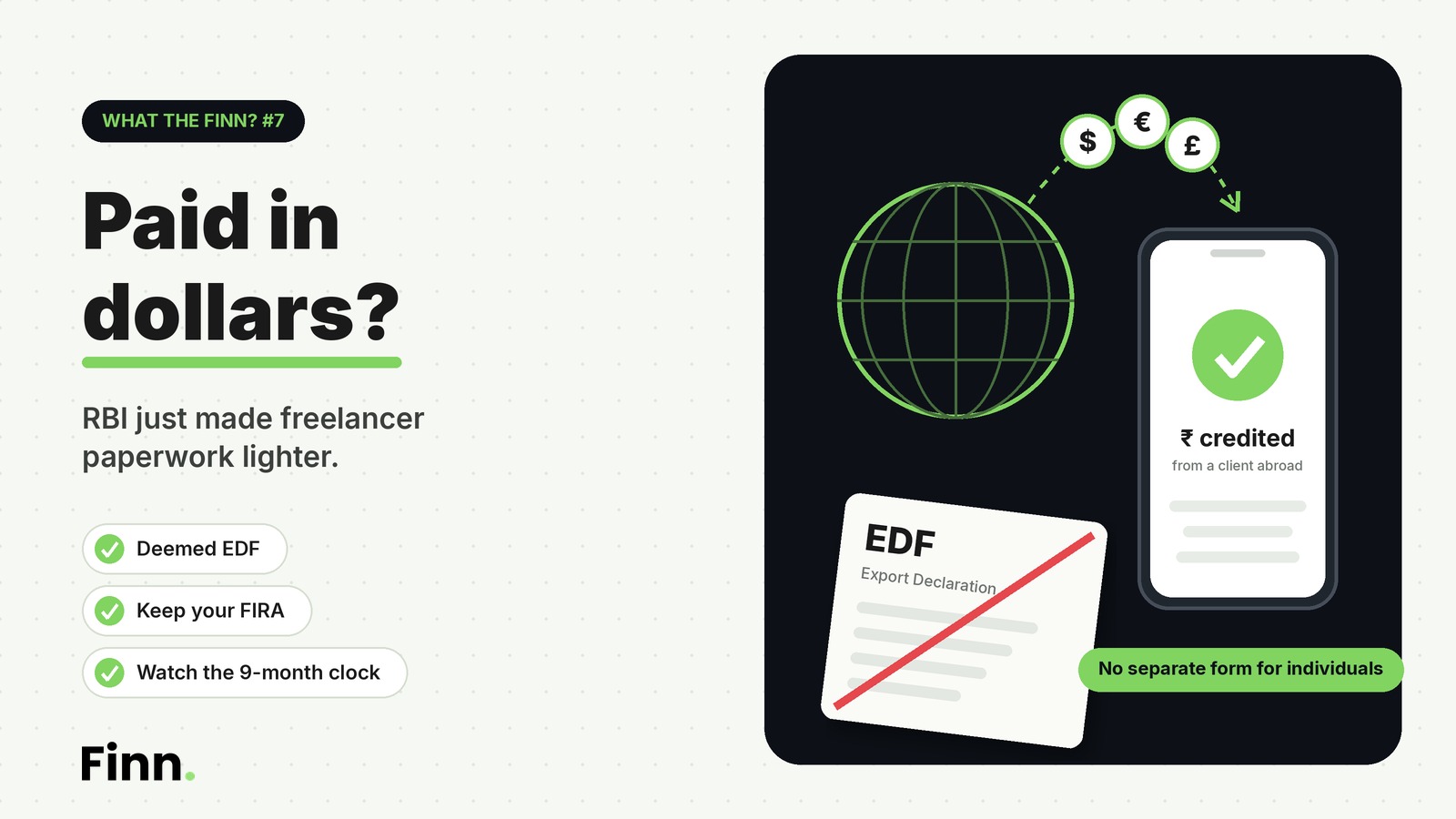
- If you're a resident individual (a person living in India, billing in your own name), you are deemed to have submitted the EDF when you give your bank the payment information it needs to credit your account.
- There's no rupee limit for individuals. A $500 payment and a $15,000 payment are treated the same way.
- If you bill through a company, LLP or partnership, the same shortcut works only when the inward remittance for a service is ₹10 lakh or less. Above that, the regular EDF filing still applies.
Translation?
If you're a freelancer working in your own name, there's no separate form.
The details your bank asks for when the money arrives are the filing.
What the Finn? 🎉
What Didn't Change 👀
"Deemed" doesn't mean "nothing to do".
It means your bank's questions now matter more.
A few things still apply:
- Answer your bank fully and quickly. Purpose of payment, invoice, client details. Under the new rule, that information is your declaration. If you ignore it, the money can sit unprocessed while you chase your branch.
- The realisation clock still runs. Export proceeds for services generally have to be realised within nine months of the invoice date (twelve months if invoiced and settled in rupees). The deemed filing doesn't pause that.
- Proprietors are a grey zone. If you bill under a trade name, or you've registered for GST, commentators don't fully agree on which rule applies to you. Ask your bank in writing.
- Your tax is still your tax. This rule is about FEMA paperwork. It doesn't change your income tax or GST.
The Two Other Things Freelancers Forget 🧐
While we're here, two quick reminders.
1. GST counts your foreign income too.
Your export earnings count towards GST's ₹20 lakh turnover threshold (₹10 lakh in some special category states). Below that, registration usually isn't mandatory. Above it, you register, and you file a Letter of Undertaking (LUT) in Form GST RFD-11 each financial year so you can invoice foreign clients without charging IGST.
2. Keep your proof of payment.
A FIRC or e-FIRA is your bank's (or payment platform's) confirmation that money reached you from abroad in foreign currency. It's the kind of document your CA will ask for at tax time and the proof GST relies on for zero-rated exports. Download it every time, not in March.
5 Habits for Freelancers Paid From Abroad ✅
1. One invoice, one payment, one folder.
Keep each invoice next to its payment advice and FIRA. Future you will be grateful.
2. Reply to your bank the same day.
A slow reply is one of the easiest ways for a foreign payment to get stuck.
3. Track the invoice date, not just the payment date.
The nine-month realisation window runs from the invoice. If a client is very late, follow up early.
4. Watch the real rupee amount.
Platform fees, conversion charges and exchange rates mean the rupees that land are often less than $1,200 at today's rate. Track what actually landed.
5. Know your running total.
Add up domestic and foreign income every month. It tells you when GST registration and your next advance tax instalment become your problem.
Where FinnDot Fits In 💚
When we talk to freelancers, the story is always similar.
"Clients pay from three countries.
Through two platforms.
Into one account.
And I still don't know what I earned this month."
That's exactly the gap we're building FinnDot for.
With your consent, FinnDot brings your financial data into one place. Our AI expense tracking sorts what came in and what went out automatically, so a client payment from abroad doesn't get lost between rent, software subscriptions and food orders.
And because freelance income doesn't arrive on the 1st of every month, we're building FinnDot to understand people with irregular income. That clarity helps when you want to build your credit score, compare credit cards or loans that fit your situation, or start with a savings-account or FD-backed card.
FinnDot doesn't file anything with your bank or RBI.
But it helps you know your numbers before anyone asks for them.
👉 Download FinnDot on Google Play
Final Thought 🌍
India's freelancers are quietly exporting design, code, content and consulting to the whole world.
For a few weeks, it looked like every one of us would need a monthly export form.
Now RBI has made it simpler for individuals.
Less paperwork.
Same responsibility.
So, honest question:
Do you work with clients outside India? What's been the most confusing part of getting paid: the bank, the platform fees, or the tax? 👇
This post is for general information only and isn't legal, tax or FEMA advice. Rules can change and your situation may differ, so please check with your bank and a qualified chartered accountant.