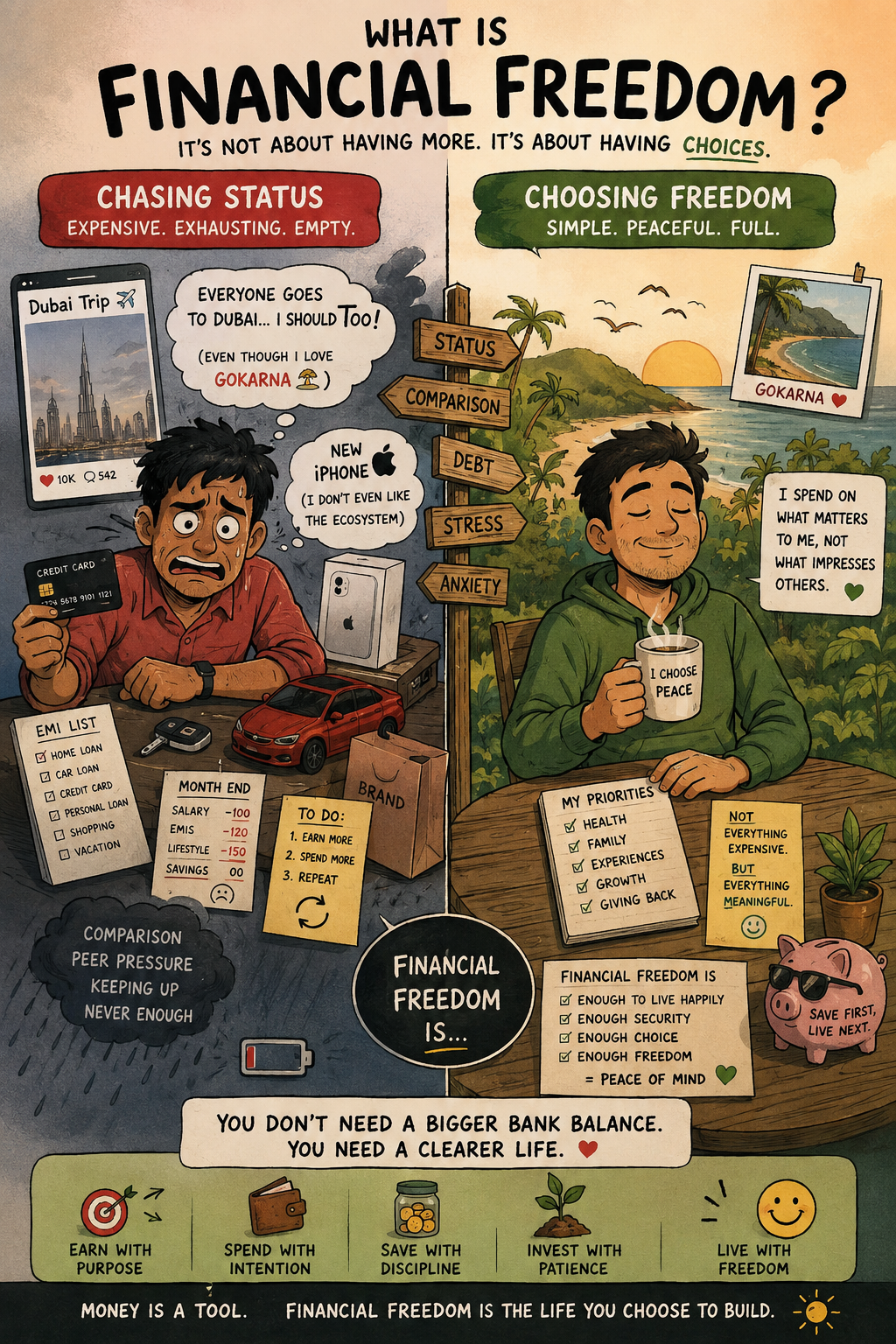
What Is Financial Freedom? And How Much Money Do You Really Need? 💰🕊️
What the Finn? — Part 3
In our previous What the Finn? article,
we asked a simple question:
Why are we chasing money so much?
Money was supposed to be a tool.
Something that helps us live.
Something that gives us security.
Something that gives us choices.
But somewhere along the way, the tool became the destination.
We work for money.
We save money.
We invest money.
And sometimes…
we spend money we don't really want to spend just to convince other people that we're doing well. 😅
Which brings us to a bigger question:
What exactly is Financial Freedom? 🕊️
When people hear financial freedom, they often imagine something like this:
🏠 A big house
🚗 A luxury car
💰 Crores sitting in investments
📈 Passive income
✈️ International holidays
💳 No EMIs
😎 And waking up at 10 AM on a Monday while everyone else is stuck in traffic.
Sounds nice.
But there is a small problem.
We often confuse looking financially successful with being financially free.
And that is where things get interesting.
The Peer Pressure Economy 😅
Let's say you love Goa.
Or maybe Gokarna.
You enjoy the beaches, the food, the relaxed atmosphere and the fact that you don't need to take a second mortgage to spend a few days there.
Then your friend comes back from Dubai.
"Bro, Dubai was amazing!"
Photos.
Burj Khalifa.
Luxury hotel.
Skyline.
Instagram story.
✨ #DubaiLife ✨
Suddenly, your perfectly enjoyable Gokarna trip feels…
less impressive.
So you book Dubai.
Not because you wanted to go.
Not because Dubai was on your bucket list.
But because…
"What will people think if I say I went to Gokarna?" 😂
Congratulations.
You have just spent ₹80,000 to upgrade your Instagram story.
Your happiness didn't change.
Your credit-card bill did.
That's the peer-pressure economy.
The iPhone Problem 📱😂
Here's another one.
You are perfectly comfortable with Android.
You know where everything is.
Your apps work.
Your files are where you expect them to be.
You don't particularly like being locked into an ecosystem.
You don't really need an iPhone.
Then your friend buys one.
Suddenly:
"Hmm… maybe I should get one too."
You buy it.
You spend ₹80,000+.
You spend the first week trying to figure out where the settings are.
"Why can't I do this like I used to?"
But that's okay.
Because now you can say:
"I have an iPhone." 😎
Meanwhile, your old phone was doing exactly the same job.
Calling.
Messaging.
Taking photos.
Watching YouTube.
Banking.
Maps.
Basically everything you needed.
But the new phone has one additional feature:
It makes you feel like you are keeping up. 😂
And that feeling can be expensive.
The Comparison Trap 👀
This is where financial freedom becomes much more complicated.
We don't just spend money to satisfy our needs.
We spend money to satisfy our social expectations.
Someone buys a bigger house.
We want a bigger house.
Someone buys a new car.
We start looking at cars.
Someone gets promoted.
We wonder why we aren't earning as much.
Someone goes to Europe.
Suddenly our perfectly good family holiday doesn't feel good enough.
Someone posts a new watch.
And suddenly the watch we've been wearing for five years looks like it belongs to our grandfather.
😂
Social media makes this worse.
Because we are constantly seeing everyone's highlight reel.
We see:
✈️ Vacations
🏎️ Cars
🏠 Houses
💼 Promotions
📈 Investments
💍 Weddings
🍽️ Restaurants
📱 Gadgets
But we don't see:
EMIs.
Loans.
Stress.
Credit-card bills.
Family responsibilities.
Job insecurity.
Sleepless nights.
We see the output.
We don't see the balance sheet.
And then we compare their highlight reel with our behind-the-scenes.
That's not a fair comparison.
Are You Chasing Your Goal or Someone Else's? 🎯
This might be one of the most important questions in personal finance.
Is the goal actually yours?
Maybe you want to earn ₹5 lakh a month.
Great.
But why?
Because you genuinely need it?
Because it supports the life you want?
Or because someone earning ₹5 lakh made you feel that your ₹1 lakh salary isn't enough?
Maybe you want a ₹2 crore house.
But do you actually want that house?
Or do you want the feeling of being the person who owns a ₹2 crore house?
Maybe you want a luxury car.
But perhaps what you actually wanted was a comfortable car that takes you from A to B without making you think about its EMI every time you start the engine.
Maybe you want to retire at 40.
Or maybe you actually enjoy your work and would happily work until 60.
There is nothing wrong with wanting more.
The problem begins when we stop asking ourselves what "more" actually means.
Financial Freedom Is Different for Everyone 🌱
Consider two people.
Person A
Earns ₹30,000 a month.
Lives simply.
Has manageable expenses.
No major debt.
Saves a little.
Spends time with family.
Enjoys their work.
Sleeps peacefully.
Person B
Earns ₹3 lakh a month.
Has a large home loan.
Car EMI.
Credit-card bills.
Expensive lifestyle.
Multiple financial commitments.
And a constant fear of losing the job.
Who is financially free?
The answer isn't necessarily Person B.
Person B has more money.
But Person A may have more freedom.
Of course, ₹30,000 isn't enough for everyone.
And ₹3 lakh may be perfectly comfortable for someone else.
That's exactly the point.
There is no universal financial-freedom number.
Your number depends on your life.
Financial Freedom Is About Choices 🕊️
Perhaps the simplest definition is:
Financial freedom is having enough financial security that money doesn't make every important decision for you.
Can you leave a job you hate?
Can you take a break?
Can you spend time with your family?
Can you pursue something you genuinely enjoy?
Can you start a business?
Can you survive an unexpected expense?
Can you say "No" to something without worrying that your entire financial life will collapse?
Can you choose meaningful work instead of simply choosing the highest-paying work?
The more choices you have, the closer you are to financial freedom.
Notice something.
None of these questions asks:
"How many crores do you have?"
But Money Still Matters 💰
Let's not go too far in the other direction.
Money matters.
A lot.
You cannot pay rent with philosophical quotes.
😂
You cannot buy groceries with "good vibes."
And telling your bank manager that you have achieved inner financial freedom probably won't help when your EMI is due.
Financial freedom requires enough money.
Enough to meet your needs.
Enough to handle emergencies.
Enough to plan for the future.
Enough to give you some breathing room.
But once those foundations are in place, the relationship changes.
More money doesn't automatically mean more freedom.
Sometimes it simply means:
more expensive problems.
A bigger house → bigger EMI.
A bigger car → bigger maintenance.
A more expensive lifestyle → greater income pressure.
More possessions → more things to maintain.
More status → more status to maintain.
And suddenly you are earning more money…
to maintain the lifestyle that requires you to earn more money.
Welcome to the treadmill. 🏃♂️
Financial Freedom Doesn't Mean Never Working 👨💻
Another common misunderstanding:
Financial freedom = never working again.
But humans are strange.
Give someone a long holiday and they may spend the first few days sleeping.
Then travelling.
Then watching movies.
Then scrolling.
And eventually:
"Okay… what am I supposed to do now?" 😂
Work isn't necessarily the enemy.
Meaningful work can give us:
Purpose.
Learning.
Achievement.
Relationships.
Creativity.
A sense of contribution.
The goal of financial freedom isn't necessarily to escape work.
It is to escape being forced into work purely because you have no financial choice.
Imagine having enough financial security that you can choose your work.
You could continue working.
Start a company.
Become a teacher.
Build something useful.
Work fewer hours.
Change careers.
Take a year off.
Or work simply because you genuinely enjoy it.
That's freedom.
So… How Much Money Is Enough? 🤔
Instead of asking:
"How much money do I need to become financially free?"
Maybe ask:
"What does a financially free life look like for me?"
Where do you want to live?
What do you actually need?
What makes you happy?
What responsibilities do you have?
What kind of work do you want?
How much lifestyle inflation are you comfortable with?
How much security do you need?
And most importantly:
Are the goals you're chasing actually yours?
Because there is no point running a very successful race…
if you are running in the wrong direction. 🏃♂️💨
Your Bank Account Doesn't Have Instagram 😂
This may be the most important lesson.
Financial freedom isn't about looking rich.
It is about being financially resilient.
You don't need to prove your financial success every time you meet someone.
Driving an old car because it works?
Smart.
Not upgrading your phone because the current one works?
Smart.
Choosing Gokarna because you genuinely enjoy it more than Dubai?
Smart.
Buying the Android you actually prefer instead of an iPhone because everyone else has one?
Also smart.
Saying no to an expensive vacation because you have another priority?
Smart.
Living below your means even when you could spend more?
Very smart.
None of these decisions may get you many Instagram likes.
But here's the good news:
Your bank account doesn't have Instagram. 😂
It doesn't care how impressive you look.
It cares whether the numbers work.
The Race With No Finish Line 🏁
There will always be someone ahead.
Someone with a bigger house.
Someone with a faster car.
Someone with a higher salary.
Someone with a larger portfolio.
Someone with a newer phone.
Someone going to a better holiday destination.
Someone building a bigger company.
If your happiness depends on being ahead of everyone else, you have created a race with no finish line.
You will keep running.
And running.
And running.
Until one day you realise:
You weren't actually trying to win.
You were just trying not to feel behind.
That's not financial freedom.
That's financial cardio. 🏃♂️😂
Maybe Financial Freedom Is Simpler Than We Think
Perhaps financial freedom is simply this:
Having enough to live happily, enough security to handle life's surprises, and enough choice to decide what you want to do with your time.
The amount will be different for everyone.
For one person, it might be ₹30,000 a month.
For another, ₹3 lakh.
For someone else, much more.
The number matters.
But the relationship between that number and the life you want matters even more.
Because money is ultimately a means to an end.
The end isn't the money.
The end is the life. ❤️
So before chasing the next salary, the next promotion, the next investment milestone, the next car, the next phone, or the next vacation your neighbour posted on Instagram…
Stop for a moment.
And ask:
"Do I actually want this?"
If the answer is yes:
Go for it. 🚀
Enjoy it.
There is nothing wrong with wanting nice things.
But if the answer is no…
You just saved yourself a lot of money.
And maybe, without even realising it, you just moved a little closer to financial freedom.
Because financial freedom isn't about having the most money.
It is about having enough money, enough discipline, and enough freedom to live your own life — not someone else's.
And perhaps that is the real meaning of enough.
Not the amount that impresses everyone else.
The amount that lets you sleep peacefully at night. 🌙
What the Finn? 💚
Last time, we asked:
“What is money?”
This time, we asked:
“What is financial freedom?”
Until next time, let's come back with another interesting question. 💚